


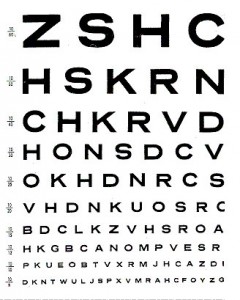
 It’s your birthday soon and in many states that means your driver’s license might be up for renewal. When was the last time you had an eye exam? Don’t be vain or shy. Not knowing if you will pass or not is stressful. Go into your next exam armed with the knowledge that your eye sight is good or that you have taken the corrective measures to make your sight “driving safe”. During driving, the eyes are constantly on the move — looking at vehicles ahead and to the side;
reading road traffic signs; checking the rear and side view mirrors, and shifting their gaze between external and internal environments in order to check the speedometer, read a map on a global navigation system, change a radio station, or search for a dropped item in the car.
During darkness, these tasks can become more difficult for some drivers. A driver with 20/20 vision during the day can experience a reduction of visual acuity to 20/40 at night.
Research findings from the Pennsylvania Department of Motor Vehicles indicate that over half of those who fail a DMV vision exam are unaware that they have a vision problem. One in four (25 percent) Americans said it has been more than two years since their last eye exam, according to Americans’ Attitudes & Perceptions About Vision Care survey, conducted by Harris Interactive® on behalf of The Vision Care InstituteTM, LLC, a Johnson & Johnson Company.
“Getting behind the wheel of a car with an uncorrected or improperly corrected vision problem can have tragic consequences,” says California-based optometrist Dr. Elise Brisco. “A comprehensive eye exam will include testing to diagnose potential problems and determine the correct form of treatment.”
In the Harris survey, 80 percent of respondents said they believe that correcting vision problems can improve their driving a great deal. Having a regular eye exam is all part of the Healthy Aging® prevention checklist.
If you need to know what to expect at a regular eye exam these days, The Mayo Clinic has a complete description which you can read by clicking here
Below are some common vision problems and how they can impact driving.
Distance vision
Poor distance vision and excessive speed can have disastrous results. If your distance vision is poor, you may not see hazards until it’s too late to react safely. The faster you travel, the less time you have to see things and react to them.
Depth Perception
You need to be able to judge distances well to pass other vehicles and change lanes, especially in busy traffic. The inability to judge distance can result in the driver stopping too short of the limit line or inside the intersection, turning too wide or too short, and/or failing to maintain speed and/or following distance appropriate for prevailing driving conditions. Poor depth perception also can result in “fender benders” and make parking more difficult.
Accommodation (near vision focusing)
When you’re driving, you need to look from the road to the dashboard and back again quite often. This ability to change focus from far to near is called accommodation or near vision focusing. Over the age of 45, most people have increasing difficulty with near vision, and may need bifocal or progressive lenses or contact lenses to help see at all distances from far to near.
Field of vision (peripheral)
In driving, peripheral or side vision is used in part to detect information that may be important for safe driving, such as road signs, appearances of hazards, and changes in the flow of traffic. The ability to see to both sides is important. You need to be able to see cross traffic, pedestrians, and animals at the roadside, without having to look away from the road ahead. Peripheral vision is also used in controlling the vehicle. When the driver looks in the rear view mirror, peripheral vision is used to monitor traffic in front of the vehicle. In keeping the vehicle centered in the lane, peripheral vision is used to monitor the lane boundaries. Peripheral vision impaired by one or more vision conditions can result in the driver failing to react to a hazard coming from the driver’s far left or far right, failing to heed a stop light suspended over an intersection, weaving while negotiating a curve, and/or driving too close to parked cars. Additionally, due to the frame, some eyeglasses also can block peripheral vision so that when looking sideways, upwards or downwards, the wearer is looking outside the perimeter of the lens.
Astigmatism
Astigmatism is a vision condition that occurs when surfaces of the eye, such as the cornea, have an oval shape — like an egg. This shape prevents light from focusing properly on the back of the eye, the retina. People with uncorrected astigmatism will usually have blurred vision, and in some cases may also experience headaches, eyestrain, or fatigue.
Night vision
The visual ability of two drivers may be about the same during the daylight hours and be markedly different during night or other low-light situations. For example, twilight is one of the most difficult times to drive, because eyes are constantly changing to adapt to the growing darkness. Drivers need to be able to see in low and variable light conditions, and recover quickly from the glare of oncoming headlights. Glare recovery is best in drivers under the age of 30, and night vision can deteriorate after the age of 40. Driving safely at night requires seeing well not only under low illumination, it also requires one to see low contrast objects. Someone wearing dark clothes and crossing the street in front of the driver is much harder to detect at night than during the day because there is much less contrast at night between darkly clothed pedestrians and a dark background. Night vision impaired by one or more vision conditions can result in a driver at night failing to react to hazards located directly in front of the vehicle, tailgating, and/or failing to steer when necessary because the driver is unable to see low contrast features of the roadway such as its edges and irregularities in the road surface.
Color vision
Color plays an important part in road safety. Drivers must instantly recognize traffic lights, indicator signs, hazard warning lights and stoplights, and people with color vision defects may react slower to them.